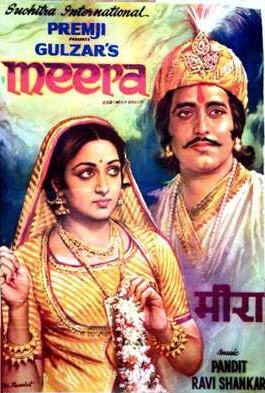
 Eighty years later, it seemed interesting to me that Gulzar sahab's birthday should fall on Janmashtami (Lord Krishna's birthday according to the Hindu calendar). The feeling was further accentuated when Rahul Roushan on twitter put up a very relevant poster of the film 'Meera' which Gulzar sahab had directed. It struck me Shrikrishna might as well have been named 'Sampooran' had he been born in Punjab!
We know the Dashavatara of Vishnu as mythology but ancient Indian scriptures were not just about religion. Dashavatara is actually the Theory of Evolution told in parables. The first avatar - Matsya (Fish) is an aquatic being. Then comes Koorma (Tortoise), the amphibian. The third avatar is Varaha (Boar), a terrestrial animal followed by fourth avatar of Narasimha (Half man, half beast). The fifth avatar is Waman - the short man or the pygmy. The sixth - Parashuram (Stone Age Man) who works with iron tools. The seventh avatar is Ram (Administrator and social animal). The eighth avatar is Krishna, the Shrimant Yogi (The complete man.) Plato's Philosopher King is very close to the concept of Krishna! The only avatar above Krishna is Buddha (the Evolved Being). Buddha is more than complete! This can only be succeeded by the tenth avatar, Kalki (Destruction).
The coincidence also reminded me of Acharya Rajneesh's lecture on Meera. Rajneesh started off by saying that Meera was a calm lake and that he was inviting the listener on a cruise of this lake!
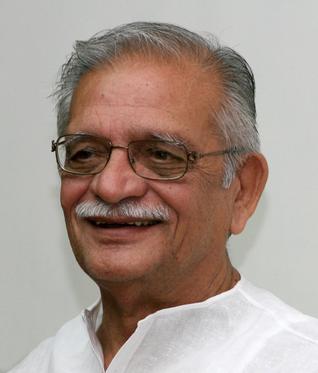 |
| Gulzar |
Gulzar's lyrics have often made references to Krishna even when there was no direct mention of Shrikrishna in the scene or the screenplay. For example in Mora Gora Ang Lai Le, Mohe Shaam rang Dai De (Sujata). In Phir Se Aiyo Badara Bidesi (Namkeen) and then again in Kajara Re (Bunty Aur Bubly) he makes reference to 'Kaali kamli wala'. Interestingly the phrase has been used for Krishna, Mohammed, Vishuddhanadji Maharaj, and Meher Baba! Quite like Krishna's peacock feather!
A very happy birthday to Gulzar and Lord Shrikrishna as well! Enjoy this song of Namkeen where the dark clouds (which is a good omen in this land of the monsoon unlike in the West where dark clouds are regarded ominous) are as abstract as Krishna or as abstract as Gulzar's poetry - whatever you choose!
Phir Se Aaiyo Badra Bidesi Tere Pankhon Pe ( Asha Bhosle ) RD Burman & Gulzar`s -Namkeen- by Coffee House
© Kaushal S. Inamdar, 2014